
Imagine that your HR department uses an AI resume scanner to save time. It works smoothly at first. Then, a rejected candidate questions why they have been filtered.
You realize that the system can not justify its decision. It is not simply a transparency gap. It has become a legal threat within the EU law.
The EU AI Act HR has emerged as the international standard of AI regulation. It must be followed by any HR system that touches the European market. This is regardless of the fact that your company may be located in another place.
It is an informative HR leader glossary blog. It describes the EU AI Act in understandable technical language. At the conclusion, you will understand the functionality of HR risk categories and the position of your tools.
Defining The EU AI Act In HR
The first comprehensive AI law is the EU AI Act. It is concerned with safety, transparency, and fairness. This is one of the key areas of concern in HR systems.
These are recruitment, promotion, and monitoring tools. Such systems impact on jobs and wages. That makes them legally sensitive.
The responsibility of AI decisions has been shifted to HR leaders. It is no longer possible to be satisfied with automation. The human responsibility is still a focus.
Helpful Resource: What is HR Tech?
Why Does It Matter?
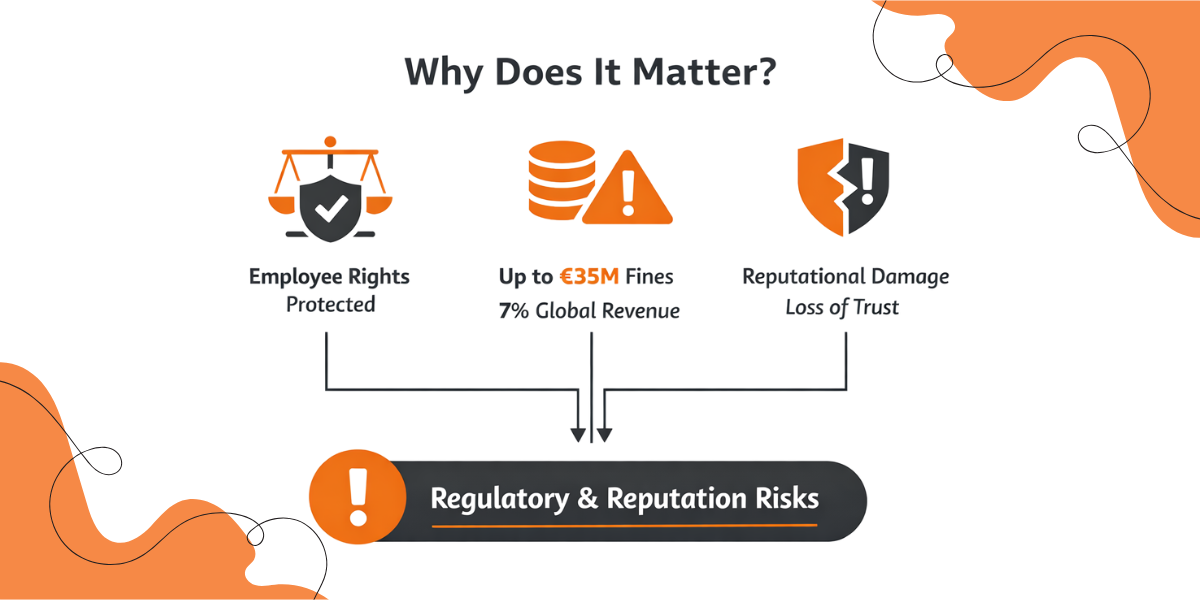
The Act secures the rights and dignity of employees. It restricts the secret bias in automatic decisions. It also enhances trust in the workplace.
There are severe consequences to non-compliance. Fines can reach EUR35 million. They are also capable of reaching 7 percent of the world turnover.
Another threat is reputational damage. Employees demand fairness. Regulators now demand proof.
How Is It Enforced?
The EU AI Act is based on a risk-based approach. Increased risk results in increased obligations. The decreasing risk will result in a reduced number of controls.
HR systems tend to be in High-Risk. They have a direct impact on employment. This provokes greater legal obligations.
Risk should be evaluated before the deployment. Controls should also be documented by you. Constant observation is necessary.
Helpful Resource: Preparing HR for the EU AI Act Compliance 2025
The Four Risk Categories Of AI
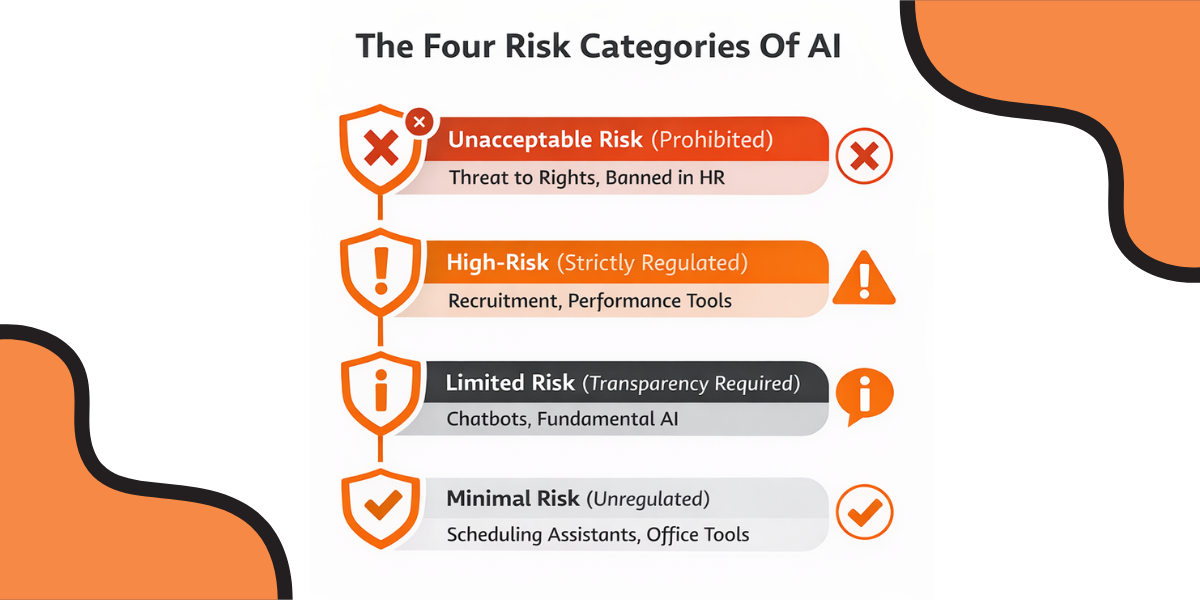
All AI systems are not equal. The burden of compliance is defined by classification. HR tools are rarely low risk.
1. Unacceptable Risk (Prohibited)
These systems are strictly prohibited. They pose a challenge to fundamental rights. No exceptions are allowed.
Emotion recognition is also banned in HR. This involves facial/voice recognition. Employees cannot be psychologically profiled.
2. High-Risk (Strictly Regulated)
Most HR AI systems fall here. They include recruitment and performance tools. The decision on promotion is also eligible.
Extreme precautions are necessary. Human oversight must exist. It is required to be fully documented.
3. Limited Risk (Transparency Required)
These are moderate risk tools. The common ones are the HR chatbots. They promote fundamental interactions.
It should tell the users clearly. They must know it is AI. Deception is not allowed.
4. Minimal Risk (Unregulated)
These tools are low-impact. Examples are scheduling assistants. Office productivity tools are also applicable.
There are no particular obligations. Voluntary codes are promoted. It is also advisable to monitor.
Risk Category Table
Key Terms To Know
Compliance is not possible without an understanding of terminology. These are the words that are used in the Act several times. HR leaders must know them.
- Deployer: It is your organization. The AI system is operationally used by you. You are legally responsible.
- Provider: This is the company that develops the AI. They place it on the market. There is no transfer of compliance.
- AI Literacy: The staff should be aware of AI use. Training is now mandatory. The abuse is no longer justifiable.
- Human Oversight: Humans must control outcomes. The decisions made by AI cannot be irreversible. Overrides must be possible.
- Conformity Assessment: This proves that there is legal compliance. It is applicable to the High-Risk systems. It has to be filled in prior to use.
Compliance Timelines: When To Act
The Act is implemented in stages. Delays are risky. Preparation should be done at an early stage.
- February 2025: It was declared illegal to engage in banned practices. Emotion recognition is not allowed. No grace period exists.
- August 2025: AI regulations are general. Large models fall here. HR integrations are influenced.
- August 2026: The high-risk HR regulations apply to most HR systems and, therefore, anticipate actual audits and stricter scrutiny.
- August 2027: The enforcement is enforced to its maximum extent, and the maximum fine can be imposed.
Helpful Resource: AI and GDPR: Key Guide for HR Leaders in 2025
TL;DR
The majority of HR AI systems are High-Risk in the EU AI Act. They need transparency, monitoring, and management. It is already illegal to practice things that are forbidden.
HRs should educate employees about AI literacy. Vendors must be compliant. Penalties can be prevented through documentation.
Conclusion
The EU AI Act may appear confusing initially. However, it does bring clarity to the HR leaders. AI can no longer be ethical by choice; it is legally required.
Risk reduction becomes quick when you see the important definitions. You also have improved people and hiring decisions. Employees are more assured that there is fairness in the outcomes.
Compliance does not solely relate to the fines. It is concerned with responsible leadership and trust. Review all AI tools that you use, classify it according to risk, and establish management with the appropriate vendors and training.
FAQs
Does The EU AI Act Apply To US Companies?
Yes. Location does not matter. In case people in the EU are impacted by AI outputs, they must comply.
Can I Still Use AI For Recruitment?
Yes, but it is High-Risk. You should make sure there is fairness, transparency, and human intervention.
What Is The First Step For HR Compliance?
Create a full AI inventory. Assigning the risk to each system. Address gaps immediately.
Get a demo to future-proof your HR systems with secure and transparent, EU AI Act-compliant solutions.


